
A jewelry business doesn’t deal in just one kind of item. There are finished ornaments, fixed-price pieces, loose diamonds, raw materials, services, certificates, and pure metal — each priced, tracked, and recorded differently. Forcing all of that into a single generic “item” category makes for messy records, inventory mismatches, and inaccurate billing. That’s why SocioLedger supports a full range of eight distinct item types, each purpose-built for a specific part of your jewelry operations.
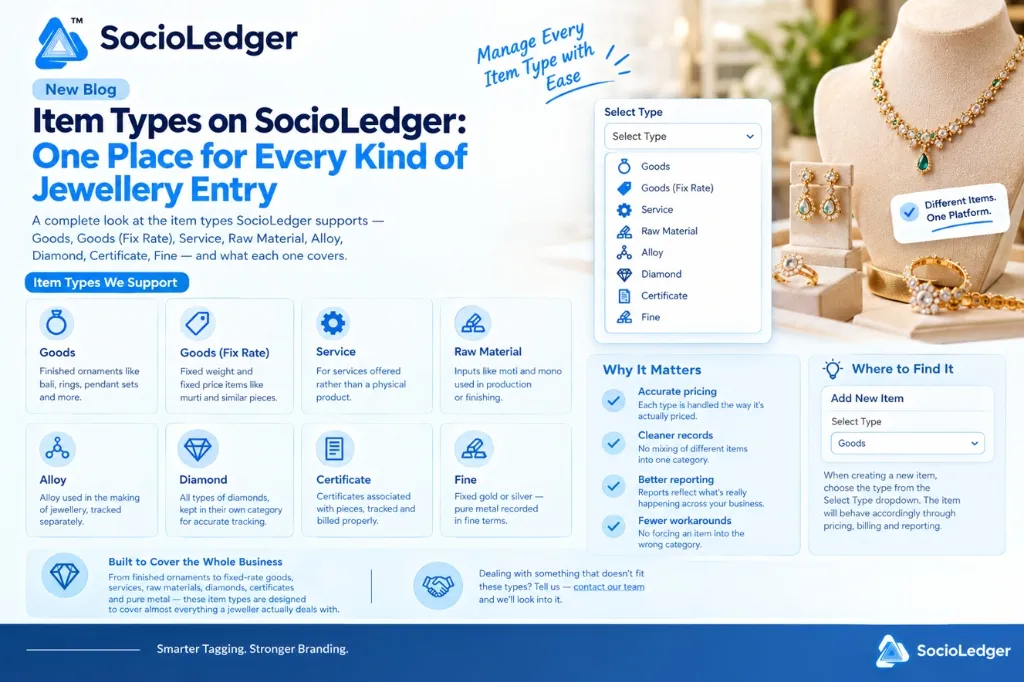
Table of contents
Open Table of contents
Why specialized item types matter in jewelry operations
In bustling jewelry hubs like Zaveri Bazaar, Karol Bagh, and Surat, daily business involves far more than just selling rings and necklaces off the shelf. On any given morning, a jeweler might purchase 24K fine bullion for casting, issue alloy and moti to a karigar workshop, sell a pair of fixed-rate silver murtis, bill a customer for ring resizing and rhodium plating, and certify a high-value solitaire diamond.
When software treats every entry as a standard generic SKU, problems multiply quickly:
- Calculation errors: Applying metal rate formulas to fixed-price murtis or labor services causes calculation errors on invoices.
- Stock distortion: Mixing loose diamond carats, pure metal weights, and finished ornament gross weights skews inventory valuation.
- Reporting chaos: Store owners cannot separate service revenue from product margins or assess raw material consumption accurately.
- Wasted staff time: Counter staff waste minutes creating complex workarounds to log services or certifications into product-only screens.
Clear classification gives every transaction a dedicated home with the exact pricing logic, weight fields, and ledger rules it needs.
The 8 item types supported in SocioLedger
SocioLedger organizes all inventory and operational entries into eight purpose-built item categories:
+-----------------------------------------------------------------------------+
|                      SocioLedger Supported Item Types                       |
+-----------------------------------------------------------------------------+
|  1. Goods               --> Finished ornaments (rings, bangles, necklaces)  |
|  2. Goods (Fix Rate)    --> Fixed-weight & fixed-price items (murtis, coins)|
|  3. Service             --> Labor, repair, rhodium, polishing, designing    |
|  4. Raw Material        --> Inputs & findings (moti, mono, base wire, beads)|
|  5. Alloy               --> Master alloys for melting & karatage conversions|
|  6. Diamond             --> Loose diamonds, solitaires, parcel lots         |
|  7. Certificate         --> IGI, GIA, SGL, and BIS hallmarking charges      |
|  8. Fine                --> Pure metal (24K gold / 999 silver) in fine terms|
+-----------------------------------------------------------------------------+
1. Goods
The core category for finished ornaments — bali, rings, pendant sets, bridal necklaces, bangles, and kada sets. This is where the majority of a typical retail or wholesale catalog lives.
- How it works: Items are defined with metal purity (such as
22K | 916or18K | 750), gross weight, net weight, itemized stone deductions (less weight), and making charges (whether per gram or percentage-based). - Pricing behavior: Automatically calculates live retail prices using real-time metal board rates combined with making charges and stone values.
2. Goods (Fix Rate)
Built for ornaments and decorative pieces that carry a fixed weight and, in many cases, a fixed overall price — items like silver murtis, stamped gold coins, novelty gift articles, and corporate medallions.
- How it works: Unlike dynamic goods where pricing changes every minute with fluctuating gold or silver market rates, fix-rate goods maintain a pre-set retail or wholesale price.
- Pricing behavior: Speeds up cashier checkouts during festive rushes by preventing accidental metal-rate calculations on fixed-price stock.
3. Service
Designed for anything offered as a service rather than a physical product. When a client is billed for skilled work performed rather than a physical ornament sold, this is the type to choose.
- How it works: Covers repair work, rhodium plating, ring resizing, pearl restringing, custom laser engraving, and CAD design fees.
- Pricing behavior: Generates clean invoice line items with proper GST service accounting (SAC codes) without subtracting physical grams or pieces from your metal inventory.
4. Raw Material
Covers raw inputs and crafting components used in making or finishing pieces — items like moti (pearls), mono/color stones, findings, locks, clasps, base wires, and solder.
- How it works: These items go into production rather than being sold directly as finished showcase ornaments.
- Pricing behavior: Tracked by piece count, carats, or weight grams, allowing precise material issue-and-receipt tracking when issuing batches to karigar job cards.
5. Alloy
Covers master alloys (such as copper-silver master alloys and specialized casting mixes) used in the manufacturing and melting of jewelry.
- How it works: Alloy is tracked strictly separately from finished goods and pure metal.
- Pricing behavior: Enables accurate melting calculations, refining tallies, and purity adjustments when converting 24K fine metal into 22K, 18K, or 14K casting batches.
6. Diamond
Covers all types of diamonds a jeweler needs to manage — kept as its own dedicated category given how differently diamonds are valued and recorded compared to metal-based items.
- How it works: Accommodates loose solitaires, certified diamonds, and multi-stone parcel lots. Tracks the 4Cs (Cut, Color, Clarity, Carat weight), sieve sizes, and cent rates.
- Pricing behavior: Values stock in carats and cents, integrating seamlessly into studded jewelry itemization and tag generation.
7. Certificate
For third-party certification and hallmarking records associated with jewelry pieces — such as IGI, GIA, SGL, or BIS hallmarking fees.
- How it works: Tracked as an independent item type so certification charges can be recorded, tracked, and billed transparently rather than buried inside miscellaneous expenses.
- Pricing behavior: Billed at fixed per-certificate or per-piece rates, linking directly to parent ornament stock numbers for complete compliance traceability.
8. Fine
Covers pure gold or silver bullion (such as 24K 999/995 fine gold bars, coins, and 999 silver grains) recorded strictly in fine weight terms.
- How it works: Distinct from finished ornaments made from precious metal, Fine items represent pure metal balances.
- Pricing behavior: Essential for bullion purchases, counter metal deposits, advance rate cuts, supplier metal reconciliations, and pure metal settlements.
Item types comparison at a glance
| Item Type | Primary Use Case | Valuation & Pricing Basis | Stock Tracking Unit | Typical Examples |
|---|---|---|---|---|
| Goods | Finished showcase jewelry | Metal rate + making charge + stones | Gross, less, & net weight | Rings, necklaces, bangles, earrings |
| Goods (Fix Rate) | Fixed-price ornaments & idols | Fixed piece price or fixed rate | Pieces / Weight | Silver murtis, gold coins, gift items |
| Service | Labor, repairs, & custom work | Fixed or variable service charge | Service count / Units | Rhodium plating, resizing, polishing |
| Raw Material | Production inputs & findings | Purchase cost per gram/carat/piece | Weight / Carats / Pieces | Moti, mono stones, clasps, locks |
| Alloy | Melting & karatage mix | Weight-based purchase cost | Grams / Kilograms | Master alloy, copper-silver mix |
| Diamond | Loose & certified stones | 4Cs valuation, cent rates, per carat | Carats (Cts) & Pieces | Solitaires, parcel lots, melee diamonds |
| Certificate | Lab grading & hallmarking | Fixed certificate charge | Number of certificates | IGI, GIA, SGL, BIS hallmark fee |
| Fine | Pure bullion & settlement metal | Daily 24K fine bullion spot rate | Fine weight (Grams / Kg) | 24K 999 gold bars, 999 silver grains |
Key operational benefits of dedicated item types
Choosing the right item type for every entry provides immediate operational advantages across your entire showroom and workshop:
- Accurate pricing: Each item type is handled the way it is actually priced — whether that is by dynamic metal weight, at a fixed rate, by carat value, or as a service fee.
- Cleaner records: A diamond, a certificate, a raw moti lot, and a finished bridal necklace never get mixed into the same generic bucket.
- Better reporting: With items properly categorized, business intelligence and sales reports reflect exactly what is happening across retail, wholesale, workshop, and bullion divisions.
- Fewer workarounds: Staff no longer need to force an unusual item into the wrong category just because there is nowhere else for it to go.
Where to find it in SocioLedger
When creating a new item in SocioLedger, you will find the Select Type dropdown listing all available item types right at the top of the item creation form.
+-------------------------------------------------------------+
|  Add New Item                                               |
+-------------------------------------------------------------+
|  Select Type                                                |
|  [ Goods                                               v ]  |
+-------------------------------------------------------------+
Simply choose the type that matches what you are adding, and the platform will automatically configure the appropriate weight fields, pricing behavior, and ledger connections throughout billing, stock tallying, and reporting.
Built to cover the whole jewelry business
Between finished ornaments, fixed-rate goods, services, raw materials, alloys, diamonds, certificates, and pure fine metal, SocioLedger is built to cover almost everything a jeweler deals with in day-to-day operations. Every entry has a proper home from the moment it is created.
Whether you are printing detailed ornament tags using our tag print formats, performing rapid checkout shortcuts, or managing multi-branch stock transfers, proper item typing ensures your entire business runs on clean, dependable data.
Dealing with an unusual item or workflow that doesn’t fit these types? Tell us — contact our team and we will look into it.